
Three-Card Spread
Difficulty: Very easy
This simple spread can be used to shed light on the influences around you. You can use the three positions to represent any trinity, like past-present-future or tension-release-resolution.
Your Three-Card Tarot Reading with the Book of Thoth
The Past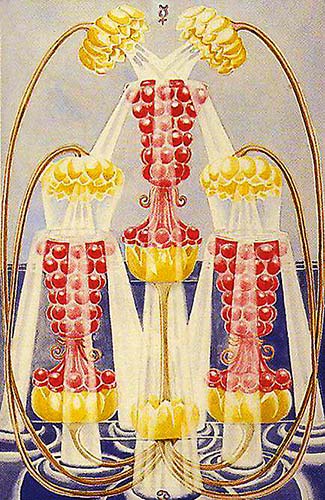 3 of Cups |
The Present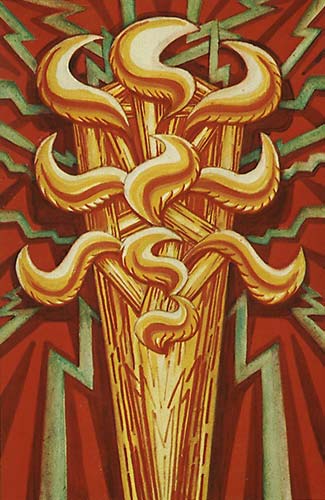 Ace of Wands |
The Future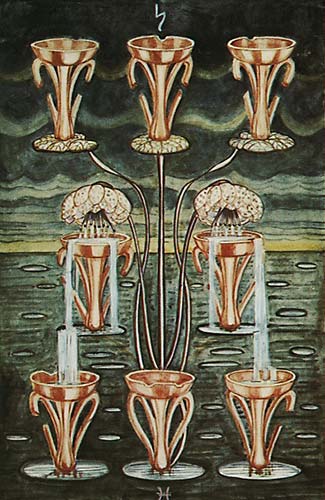 8 of Cups |
The Past
3 of Cups
Mercury in Cancer – Abundance
This card refers to Binah in the suit of Water. This is the card of Demeter or Persephone. The Cups are pomegranates: they are filled bountifully to overflowing a single lotus, arising from the dark calm sea characteristic of Binah. There is here the fulfilment of the Will of Love in abounding joy. It is the spiritual basis of fertility.
The card is referred to the influence of Mercury in Cancer; this carries further the above thesis. Mercury is the Will or Word of the All-Father; here its influence descends upon the most receptive of the Signs. At the same time, the combination of these forms of energy brings in the possibility of somewhat mysterious ideas. Binah, the Great Sea, is the Moon in one aspect, but Saturn in another; and Mercury, besides being the Word or Will of the All-One, is the guide of the souls of the Dead. The pomegranate was the fruit which Persephone ate in the realms of Pluto, thereby enabling him to hold her in the lower world, even after the most powerful influence had been brought to bear. The lesson seems to be that the good things of life, although enjoyed, should be distrusted.
The Present
Ace of Wands
The Root of Fire
This card represents the essence of the element of Fire in its inception. It is a solar-phallic outburst of flame from which spring lightnings in every direction. These flames are Yods, arranged in the form of the Tree of Life.
It is the primordial Energy of the Divine manifesting in Matter, at so early a stage that it is not yet definitely formulated as Will.
The Future
8 of Cups
Saturn in Pisces – Indolence
Lotuses droop for lack of sun and rain, and the soil is poison to them; only two of the stems show blossoms at all. The cups are shallow, old and broken. They are arranged in three rows; of these the upper row of three is quite empty. Water trickles from the two flowers into the two central cups, and they drip into the two lowest without filling them. The background of the card shows pools, or lagoons, in very extensive country, incapable of cultivation; only disease and miasma tic poison can flourish in those vast Bad Lands. The water is dark and muddy. On the horizon is a pallid, yellowish light, weighed down by leaden clouds of indigo.