
The Golden Dawn or Thoth Method
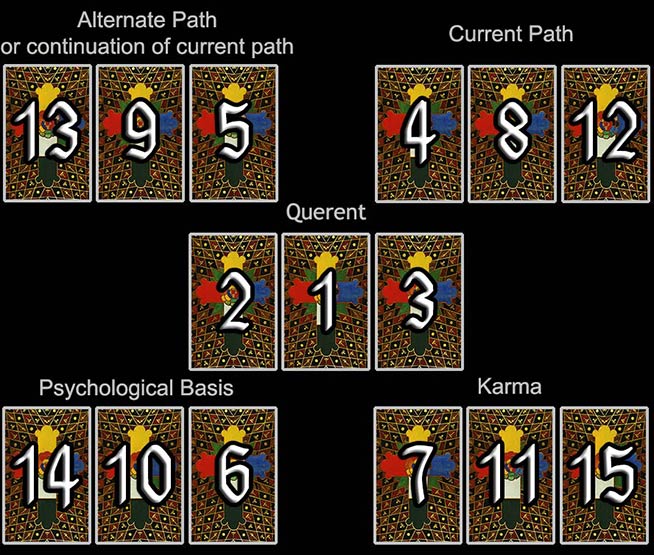
Difficulty: Complicated
Note: Decks that use reversed cards such as the Rider-Waite do not work well with this spread, which was designed to be read using elemental dignities.
The Golden Dawn spread is best suited for use with the bifrost Tarot and especially the Book of Thoth, as these decks are meant to be read a certain way with the Court cards. Princes and Queens represent actual men and women connected with the matter, while Princesses generally represent ideas; thoughts or opinions, and Knights represent arrival or departure of a matter depending on the direction faced.
In this spread, particular attention should be payed to a card’s exact position in relation to its neighbors. Whether the neighbor cards bear the same energy (suit) determines whether a card is considered well- or ill-dignified. Opposite suits ill-dignify each other, while other suits are considered friendly. Cards of the same suit strengthen each other.
As with other spreads, it is important to count the cards’ tendencies, such as whether there is a lot of one particular suit or number pattern. The patterns will reveal special messages. Lots of Majors indicates higher forces at work, lots of cups suggest strong emotions, etc.
Card #1 represents the querent and the nature of the topic at hand.
Cards #2 & #3 are used in conjunction with #1 to further comprehend the nature of the topic.
Your Golden Dawn Reading with the Thoth Tarot
| The Alternate Path (or Extension of Current Path) |
Your Current Path |
|||||
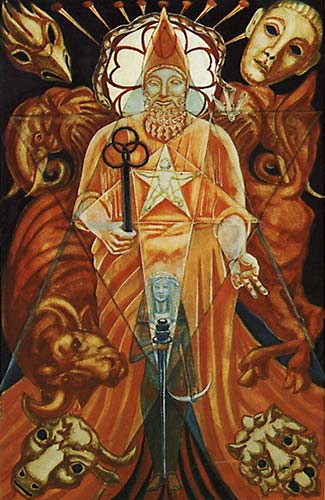 The Hierophant |
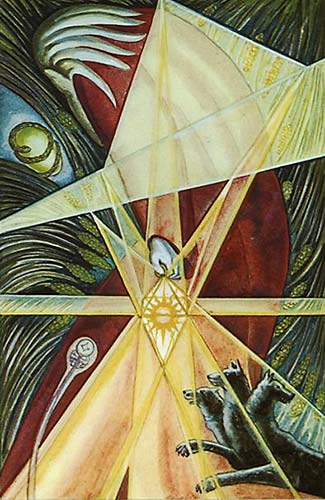 The Hermit |
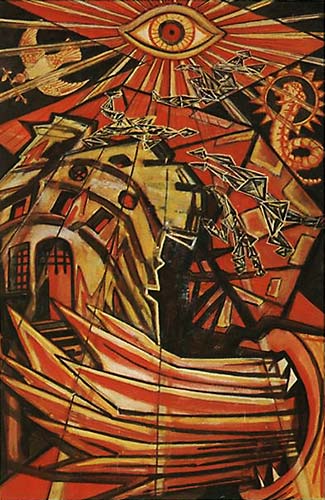 The Tower |
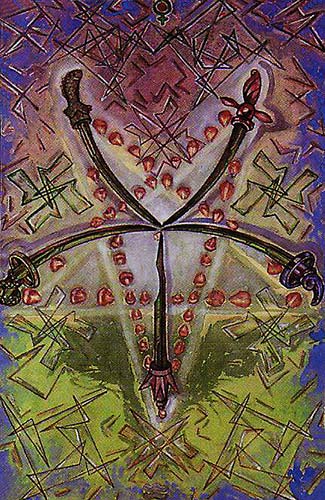 5 of Swords |
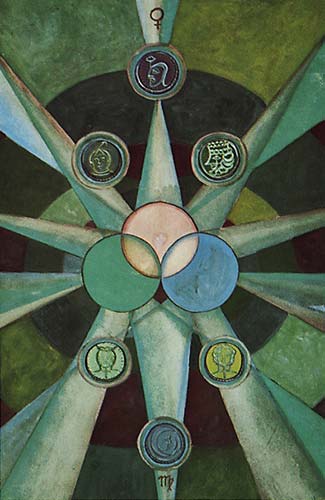 9 of Disks |
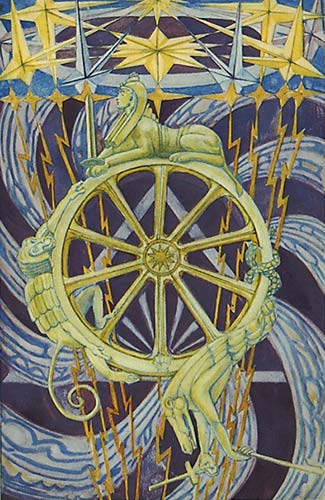 Fortune |
|
| The Querent | ||||||
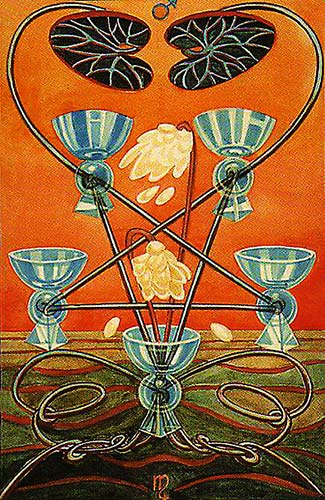 5 of Cups |
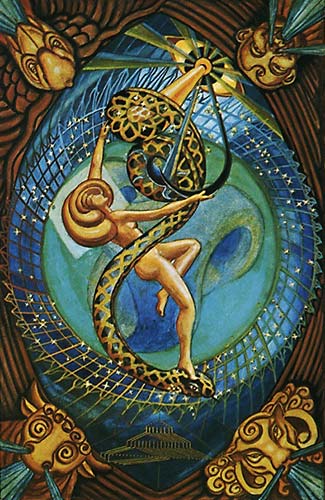 The Universe |
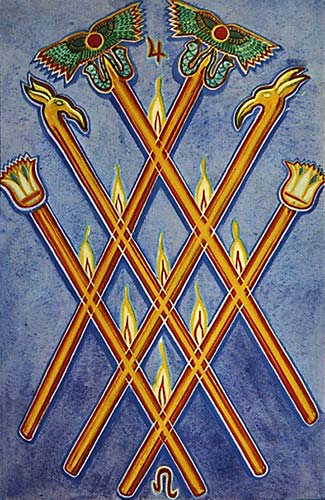 6 of Wands |
||||
| The Psychological Basis | Karma | |||||
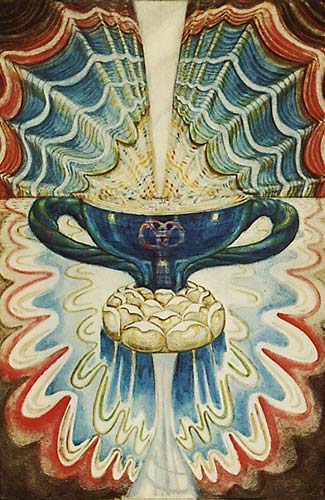 Ace of Cups |
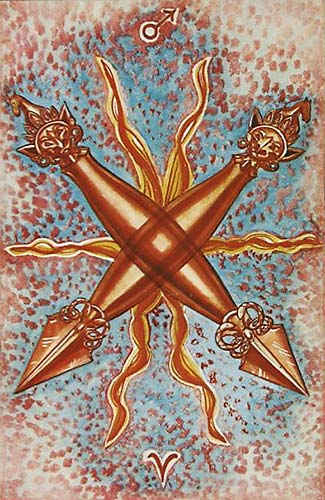 2 of Wands |
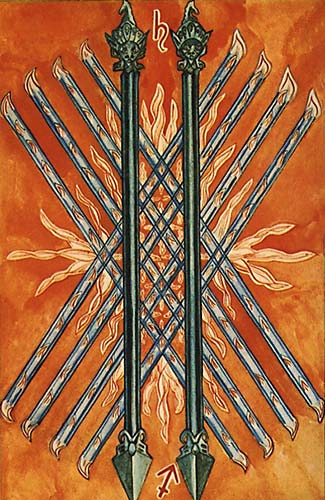 10 of Wands |
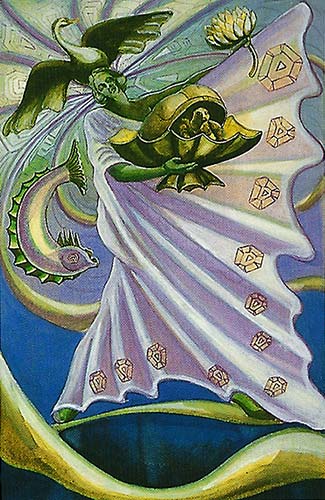 Princess of Cups |
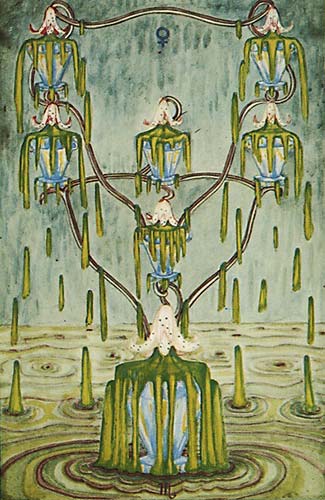 7 of Cups |
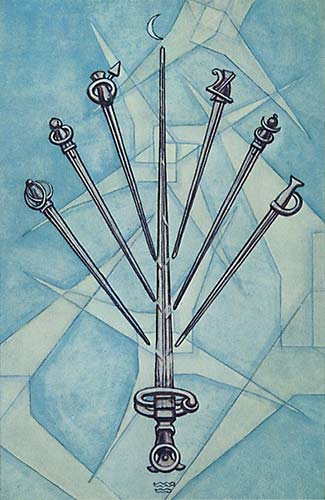 7 of Swords |
|
This spread is set up to read a certain way with the Court cards. Princes and Queens represent actual men and women connected with the matter, while Princesses generally represent ideas; thoughts or opinions, and Knights represent arrival or departure of a matter depending on the direction faced.
In this spread particular attention should be payed to a card's exact position in relation to its neighbors. Whether the neighbor cards bear the same energy (suit) determines whether a card is considered well- or ill-dignified. Opposite suits ill-dignify each other, while other suits are considered friendly. Cards of the same suit strengthen each other.
Also it is important to count the cards' tendencies, such as whether there is a lot of one particular suit or number pattern. Patterns reveal special messages. Lots of trumps means higher forces at work, lots of cups means strong emotions, etc.
The Querent
cards represent the querent and the nature of the topic at hand. The first card (in the center of the spread) represents the very core of the matter, and the other two cards around it are added to it in order to further comprehend the nature of the topic.
Earth
The matter of the question itself, synthesis, the end of the matter, may mean delay, opposition, obstinacy, inertia, patience, perseverance, persistent stubbornness in difficulty. The crystallisation of the whole matter involved.
Mars in Scorpio – Disappointment
This card is ruled by Geburah in the suit of Water. Geburah being fiery, there is a natural antipathy. Hence arises the idea of disturbance, just when least expected, in a time of ease. The attribution is also to Mars in Scorpio, which is his own house; and Mars is the manifestation on the lowest plane of Geburah, while Scorpio, in its worst aspect, suggests the putrefying power of Water.
Yet the powerful male influences do not show actual decay, only the beginning of destruction; hence, the anticipated pleasure is frustrated. The Lotuses have their petals torn by fiery winds; the sea is arid and stagnant, a dead sea, like a 'chott' in North Africa. No water flows into the cups. Moreover, these cups are arranged in the form of an inverted pentagram, symbolising the triumph of matter over spirit.
Jupiter in Leo – Victory
This card represents Tiphareth of the suit of Fire. This shows Energy in completely balanced manifestation. The Five has broken up the closed forces of the Four with revolutionary ardour, but a marriage has taken place between them; and the result is the Son, and the Sun.
The reference is also to Jupiter and Leo, which seems to imply a benediction on the harmony and beauty of this arrangement. It Will be seen that the Three Wands of the Three Adepts are now orderly arranged; and the flames themselves, instead of shooting out in all directions, burn steadily as in lamps. They are nine in number, in reference to Yesod and the Moon. This shows the stabilisation of the Energy, and its reception and reflection by the Feminine.
There is no circle to enclose the system. It is self-supporting, like the Sun.
Your Current Path
cards represent your current path as it would unfold naturally. These cards are read in chronological order from left to right.
Venus in Aquarius – Defeat
The intellect has been enfeebled by sentiment. The defeat is due to pacifism. Treachery also may be implied.
The hilts of the swords form the inverted pentagram, always a symbol of somewhat sinister tendency. Here matters are even worse; none of the hilts resembles any of the others, and their blades are crooked or broken. They give the impression of drooping; only the lowest of the swords points upwards, and this is the least effective of the weapons. The rose of the previous card has been altogether disintegrated.
Venus in Virgo – Gain
The number Nine, Yesod, inevitably brings back the balance of Force in fulfilment. The card is ruled by Venus in Virgo. It shows good luck attending material affairs, favour and popularity.
The disks are arranged as an equilateral triangle of three, apex upwards, close together; and, surrounded at some distance by a ring, six larger disks in the form of a hexagon. This signifies the multiplication of the original established Word-by the mingling of 'good luck and good management'. The three central disks are of the magical pattern as in earlier cards; but the others, since the descent into matter implies the gradual exhaustion of the original whirling energy, now take on the form of coins. These may be marked with the magical images of the appropriate planets.
Jupiter
Change of fortune. (This generally means good fortune because the fact of consultation implies anxiety or discontent.)
The Alternate Path
cards represent the alternate path that you could choose to take in lieu of the Current Path. However, if the cards that come up seem to indicate that they go along with the Current Path, these three cards should be interpretted not as an Alternate Path, but as a chronological extension of the Current Path (also read from left to right).
Taurus
Stubborn strength, toil, endurance, placidity, manifestation, explanation, teaching, goodness of heart, help from superiors, patience, organisation, peace.
Virgo
Illumination from within, secret impulse from within; practical plans derived accordingly. Retirement from participation in current events.
Mars
Quarrel, combat, danger, ruin, destruction of plans, sudden death, escape from prison.
The Psychological Basis
cards shed light upon the psychological undertones of the current problem.
The Root of Water
This card represents the element of Water in its most secret and original form. It is the feminine complement of the Ace of Wands, and is derived from the Yoni and the Moon exactly as that is from the Lingam and the Sun. The third in the Hierarchy. This accordingly represents the essential form of the Holy Grail. Upon the dark sea of Binah, the Great Mother, are Lotuses, two in one, which fill the cup with the Life-fluid, symbolically represented either as Water, as Blood, or as Wine, according to the selected purpose of the symbolism.
Above the Cup, descending upon it, is the Dove of the Holy Ghost, thus consecrating the element. At the base of the Cup is the Moon, for it is the virtue of this card to conceive and to produce the second form of its Nature.
Mars in Aries – Dominion
This card, pertaining to Chokmah in the suit of Fire, represents the Will in its most exalted form. It is an ideal Will, independent of any given object.
'For pure will, unassuaged of purpose, delivered from the lust of result, is every way perfect'. AL. 1. 44.
The background of this card shows the power of the planet Mars in his own sign Aries, the first of the Signs. It there represents Energy initiating a Current of Force. The pictorial representation is two Dorjes crossed. The Dorje is the Tibetan symbol of the thunderbolt, the emblem of celestial Power, but more in its destructive than its creative form. More, that is, in its earlier rather than its later form. For destruction may be regarded as the first step in the creative process. The virgin ovum must be broken in order to fertilise it. Fear and repulsion are therefore the primary reaction to the assault. Then, with understanding of the complete plan, willing surrender rejoices to co-operate. Six flames issue from the centre. This indicates the influence of the Sun, who is exalted in Aries. This is the creative Will.
Saturn in Sagittarius – Oppression
The number Ten refers to Malkuth, which depends from the other nine Sephiroth, but is not directly in communication with them. It shows the Force detached from its spiritual sources. It is become a blind Force; so, the most violent form of that particular energy, without any modifying influences. The flames in the back ground of the card have run wild. It is Fire in its most destructive aspect.
The whole picture suggests Oppression and repression. It is a stupid and obstinate cruelty from which there is no escape. It is a Will which has not understood anything beyond its dull purpose, its 'lust of result', and will devour itself in the conflagrations it has evoked.
Karma
These cards represent the influences of karma and destiny that are beyond your control. They suggest adapting to this fate.
The Princess of Cups represents the earthy part of Water; in particular, the faculty of crystallisation. She represents the power of Water to give substance to idea, to support life, and to form the basis of chemical combination. She is represented as a dancing figure, robed in a flowing garment on whose edges crystals are seen to form.
For her crest she wears a swan with open wings. The symbolism of this swan reminds one of the swan in oriental philosophy which is the word AUM or AUMGN, which is the symbol of the entire process of creation. She bears a covered cup from which issues a tortoise. This is again the tortoise which in Hindu philosophy supports the elephant on whose back is the Universe. She is dancing upon a foaming sea in which disports himself a dolphin, the royal fish, which symbolises the power of Creation. The character of the Princess is infinitely gracious. All sweetness, all voluptuousness, gentleness, kindness and tenderness are in her character. She lives in the world of Romance, in the perpetual dream of rapture. On a superficial examination she might be thought selfish and indolent, but this is a quite false impression; silently and effortlessly she goes about her work.
Venus in Scorpio – Debauch
This card refers to the Seven, Netzach, in the suit of Water. Here recurs the invariable weakness arising from lack of balance; also, the card is governed by Venus in Scorpio. Her dignity is not good in this Sign; one is reminded that Venus is the planet of Copper, 'external splendour and internal corruption'. The Lotuses have become poisonous, looking like tiger-lilies; and, instead of water, green slime issues from them and overflows, making the Sea a malarious morass. It is a wholesome reminder of the fatal ease with which a Sacrament may be profaned and prostituted.
Moon in Aquarius – Futility
Netzach, in the suit of Swords, does not represent such catastrophe as in the other suits, for Netzach, the Sephira of Venus, means victory. There is, therefore, a modifying influence; and this is accentuated by the celestial rule of the Moon in Aquarius.
The intellectual wreckage of the card is thus not so vehement as in the Five. There is vacillation, a wish to compromise, a certain toleration. But, in certain circumstances, the results may be more disastrous than ever. This naturally depends upon the success of the policy. This is always in doubt as long as there exist violent, uncompromising forces which take it as a natural prey. This card, like the Four, suggests the policy of appeasement.
The symbol shows six Swords with their hilts in crescent formation. Their points meet below the centre of the card, impinging upon a blade of a much larger up-thrusting sword, as if there were a contest between the many feeble and the one strong. He strives in vain.