
The Golden Dawn or Thoth Method
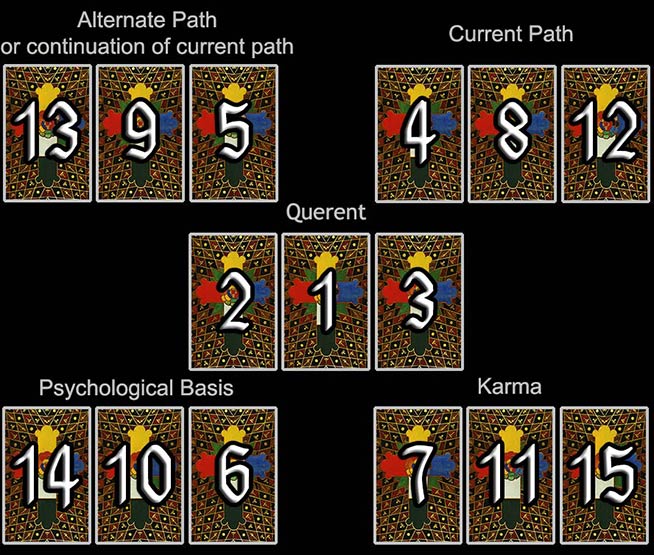
Difficulty: Complicated
Note: Decks that use reversed cards such as the Rider-Waite do not work well with this spread, which was designed to be read using elemental dignities.
The Golden Dawn spread is best suited for use with the bifrost Tarot and especially the Book of Thoth, as these decks are meant to be read a certain way with the Court cards. Princes and Queens represent actual men and women connected with the matter, while Princesses generally represent ideas; thoughts or opinions, and Knights represent arrival or departure of a matter depending on the direction faced.
In this spread, particular attention should be payed to a card’s exact position in relation to its neighbors. Whether the neighbor cards bear the same energy (suit) determines whether a card is considered well- or ill-dignified. Opposite suits ill-dignify each other, while other suits are considered friendly. Cards of the same suit strengthen each other.
As with other spreads, it is important to count the cards’ tendencies, such as whether there is a lot of one particular suit or number pattern. The patterns will reveal special messages. Lots of Majors indicates higher forces at work, lots of cups suggest strong emotions, etc.
Card #1 represents the querent and the nature of the topic at hand.
Cards #2 & #3 are used in conjunction with #1 to further comprehend the nature of the topic.
Your Golden Dawn Reading with the Thoth Tarot
| The Alternate Path (or Extension of Current Path) |
Your Current Path |
|||||
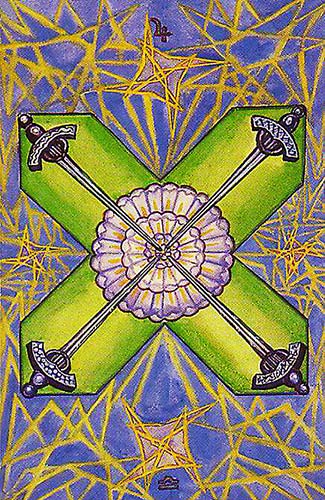 4 of Swords |
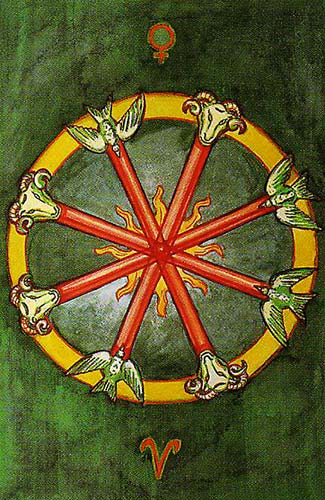 4 of Wands |
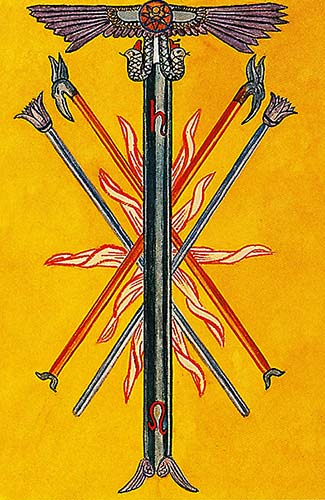 5 of Wands |
 Fortune |
 8 of Wands |
 The Aeon |
|
| The Querent | ||||||
 4 of Disks |
 9 of Disks |
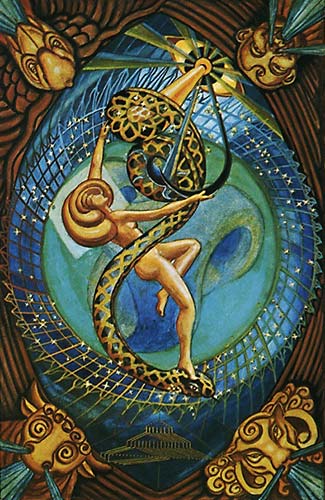 The Universe |
||||
| The Psychological Basis | Karma | |||||
 Princess of Disks |
 The Hanged Man |
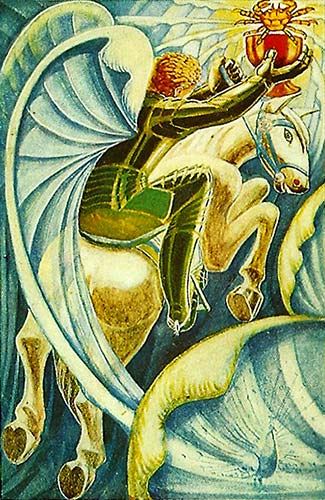 Knight of Cups |
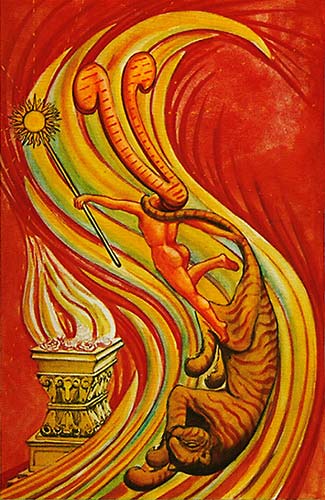 Princess of Wands |
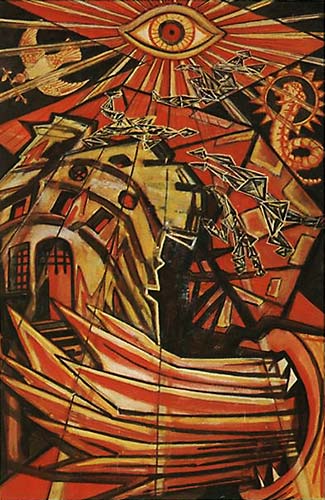 The Tower |
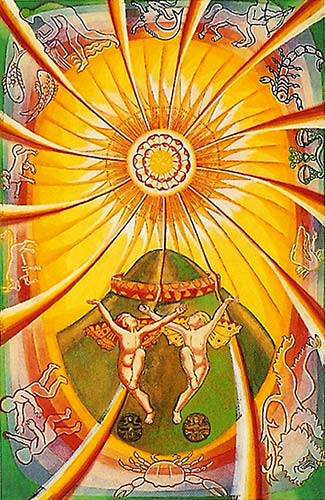 The Sun |
|
This spread is set up to read a certain way with the Court cards. Princes and Queens represent actual men and women connected with the matter, while Princesses generally represent ideas; thoughts or opinions, and Knights represent arrival or departure of a matter depending on the direction faced.
In this spread particular attention should be payed to a card's exact position in relation to its neighbors. Whether the neighbor cards bear the same energy (suit) determines whether a card is considered well- or ill-dignified. Opposite suits ill-dignify each other, while other suits are considered friendly. Cards of the same suit strengthen each other.
Also it is important to count the cards' tendencies, such as whether there is a lot of one particular suit or number pattern. Patterns reveal special messages. Lots of trumps means higher forces at work, lots of cups means strong emotions, etc.
The Querent
cards represent the querent and the nature of the topic at hand. The first card (in the center of the spread) represents the very core of the matter, and the other two cards around it are added to it in order to further comprehend the nature of the topic.
Venus in Virgo – Gain
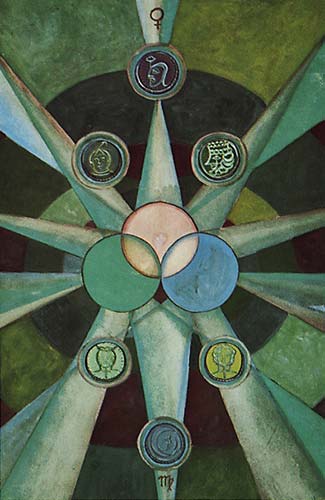
The number Nine, Yesod, inevitably brings back the balance of Force in fulfilment. The card is ruled by Venus in Virgo. It shows good luck attending material affairs, favour and popularity.
The disks are arranged as an equilateral triangle of three, apex upwards, close together; and, surrounded at some distance by a ring, six larger disks in the form of a hexagon. This signifies the multiplication of the original established Word-by the mingling of 'good luck and good management'. The three central disks are of the magical pattern as in earlier cards; but the others, since the descent into matter implies the gradual exhaustion of the original whirling energy, now take on the form of coins. These may be marked with the magical images of the appropriate planets.
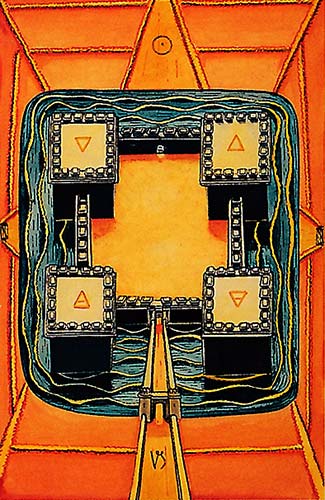
Sun in Capricorn – Power
The Four, Chesed, shows the establishment of the Universe in three dimensions, that is, below the Abyss. The generating idea is exhibited in its full material sense. The card is ruled by the Sun in Capricornus, the Sign in which he is reborn. The disks are very large and solid; the suggestion of the card is that of a fortress. This represents Law and Order, maintained by constant authority and vigilance. The disks themselves are square; revolution is very opposite to the card; and they contain the signs of the Four Elements. For all that, they revolve; defence is valid only when violently active.
So far as it appears stationary, it is the 'dead centre' of the engineer; and Capricornus is the point at which the Sun 'turns again Northward'. The background is of deep azure, flecked yellow, suggesting a moat; but beyond this is a pattern of green and indigo to represent the guarded fields whose security is assured by the fortress.
Earth
The matter of the question itself, synthesis, the end of the matter, may mean delay, opposition, obstinacy, inertia, patience, perseverance, persistent stubbornness in difficulty. The crystallisation of the whole matter involved.
Your Current Path
cards represent your current path as it would unfold naturally. These cards are read in chronological order from left to right.
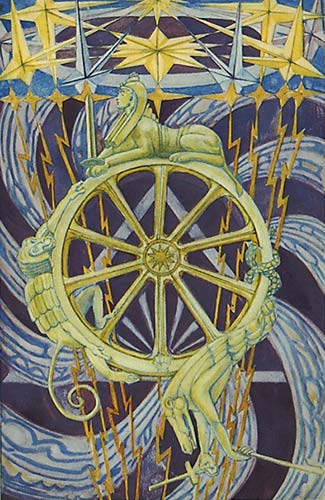
Jupiter
Change of fortune. (This generally means good fortune because the fact of consultation implies anxiety or discontent.)
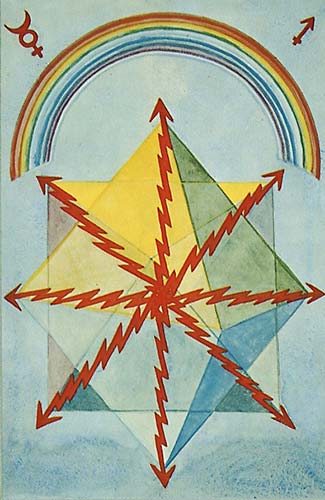
Mercury in Sagittarius – Swiftness
The card refers to Hod, splendour, in the suit of Fire, whence it refers to the phenomena of speech, light, electricity. The pictorial representation of the card shows the Light-wands turned into electrical rays, sustaining or even constituting Matter by their vibrating energy. Above this restored universe shines the rainbow; the division of pure light, which deals with maxima, into the seven colours of the spectrum, which exhibit interplay and correlation.
This card, therefore, represents energy of high velocity, such as furnishes the master-key to modern mathematical physics.
Fire
Final decision in respect of the past, new current in respect of the future; always represents the taking of a definite step.
The Alternate Path
cards represent the alternate path that you could choose to take in lieu of the Current Path. However, if the cards that come up seem to indicate that they go along with the Current Path, these three cards should be interpretted not as an Alternate Path, but as a chronological extension of the Current Path (also read from left to right).
Jupiter in Libra – Truce
Chesed refers to Jupiter who rules in Libra in this decanate. The sum of these symbols is therefore without opposition; hence the card proclaims the idea of authority in the intellectual world. It is the establishment of dogma, and law concerning it. It represents a refuge from mental chaos, chosen in an arbitrary manner. It argues for convention.
The hilts of the four Swords are at the corner of a St. Andrew's cross. Their shape suggests fixation and rigidity. Their points are sheathed – in a rather large rose of forty-nine petals representing social harmony. Here, too, is compromise.
Minds too indolent or too cowardly to think out their own problems hail joyfully this policy of appeasement. As always, the Four is the term; as in this case there is no true justification for repose, its disturbance by the Five holds no promise of advance; its static shams go pell-mell into the melting-pot; the issue is mere mess, usually signalised by foetid stench. But it has to be done!
Venus in Aries – Completion
This card refers to Chesed in the suit of Fire. Being below the Abyss, it is the Lord of all manifested active Power. The original Will of the Two has been transmitted through the Three, and is now built up into a solid system: Order, Law, Government. It is also referred to Venus in Aries, which indicates that one cannot establish one's work without tact and gentleness. The wands are headed by the Ram, sacred to Chesed, the Father-god Amoun-Ra, as also to Aries; but at the other end of the wands are the Doves of Venus.
In the symbol, the ends of the wands touch a circle, showing the completion and limitation of the original work. It is within this circle that the flames (four double, as if to assert the balance) of the Energy are seen to play, and there is no intention to increase the scope of the original Will.
Saturn in Leo – Strife
This card is referred to Geburah of the suit of Fire. Geburah itself being fiery, it is a purely active force. It is ruled also by Saturn and Leo. Leo shows the element of Fire at its strongest and most balanced. Saturn tends to weigh it down and to embitter it. There is no limit to the scope of this volcanic energy.
The symbol represents the wand of the Chief Adept, showing that the authority is derived from the superiors; were it not so, this card would be thoroughly disastrous. Moreover, there are also two wands of the Second, or Major Adept. They have the head of the Phoenix, which gives the idea of destruction (or rather purgation) through fire, and the resurrection of the energy from its ashes.
The Psychological Basis
cards shed light upon the psychological undertones of the current problem.
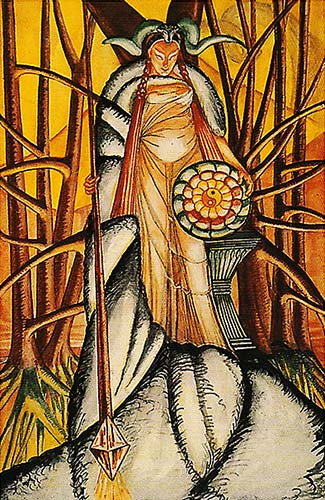
The Princess of Disks represents the earthy part of Earth. She is consequently on the brink of transfiguration. She is strong and beautiful, with an expression of intense brooding, as if about to become aware of secret wonder.
Her crest is the head of the ram, and her sceptre descends into the earth. There its head becomes a diamond, the precious stone of Kether, thus symbolising the birth of the highest and purest light in the deepest and darkest of the Elements. She stands within a grove of sacred trees before an altar suggesting a wheatsheaf, for she is a priestess of Demeter. She bears within her body the secret of the future. Her sublimity is further emphasised by the disk which she bears; for in the centre thereof is the Chinese ideogram denoting the twin spiral force of Creation in perfect equilibrium; from this is born the rose of Isis, the great fertile Mother.
Water
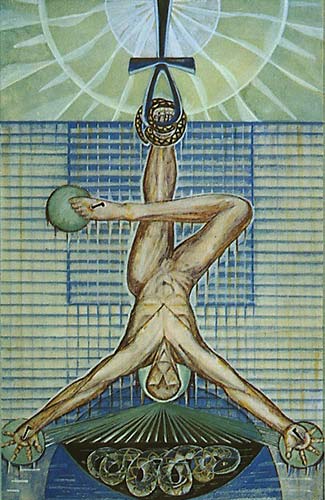
Enforced sacrifice, punishment, loss, fatal or voluntary, suffering, defeat, failure, death.
Pisces
The Knight of Cups represents the fiery part of Water, the swift passionate attack of rain and springs; more intimately, Water's power of solution. He is clothed in black armour furnished with bright wings which, together with the leaping attitude of his white charger, indicates that he represents the most active aspect of Water. In his right hand he bears a cup from which issues a crab, the cardinal sign of Water, for aggressiveness. His totem is the peacock, for one of the stigmata of water in its most active form is brilliance. There is here also some reference to the phenomena of fluorescence.
The characteristics of the person signified by this card are nevertheless mostly passive, in accordance with the Zodiacal attribution. He is graceful, dilettante, with the qualities of Venus, or a weak Jupiter. He is amiable in a passive way. He is quick to respond to attraction, and easily becomes enthusiastic under such stimulus; but he is not very enduring. He is exceedingly sensitive to external in fluence, but with no material depth in his character.
Karma
These cards represent the influences of karma and destiny that are beyond your control. They suggest adapting to this fate.
The Princess of Wands represents the earthy part of Fire; one might say, she is the fuel of Fire. This expression implies the irresistible chemical attraction of the combustible substance. The Princess is therefore shewn with the plumes of justice streaming like flames from her brow; and she is unclothed, shewing that chemical action can only take place when the element is perfectly free to combine with its partner.
This card may be said to represent the dance of the virgin priestess of the Lords of Fire, for she is in attendance upon the golden altar ornamented with rams' heads) symbolising the fires of Spring. The character of the Princess is extremely individual. She is brilliant and daring. She creates her own beauty by her essential vigour and energy. The force of her character imposes the impression of beauty upon the beholder. In anger or love she is sudden, violent, and implacable. She consumes all that comes into her sphere. She is ambitious and aspiring, full of enthusiasm which is often irrational. She never forgets an injury, and the only quality of patience to be found in her is the patience with which she lies in ambush to avenge.
Mars
Quarrel, combat, danger, ruin, destruction of plans, sudden death, escape from prison.
The Sun
Glory, gain, riches, triumph, pleasure, frankness, truth, shame-lessness, arrogance, vanity, manifestation, recovery from sickness, but sometimes sudden death.